⚠️ Theoretical Research Preface
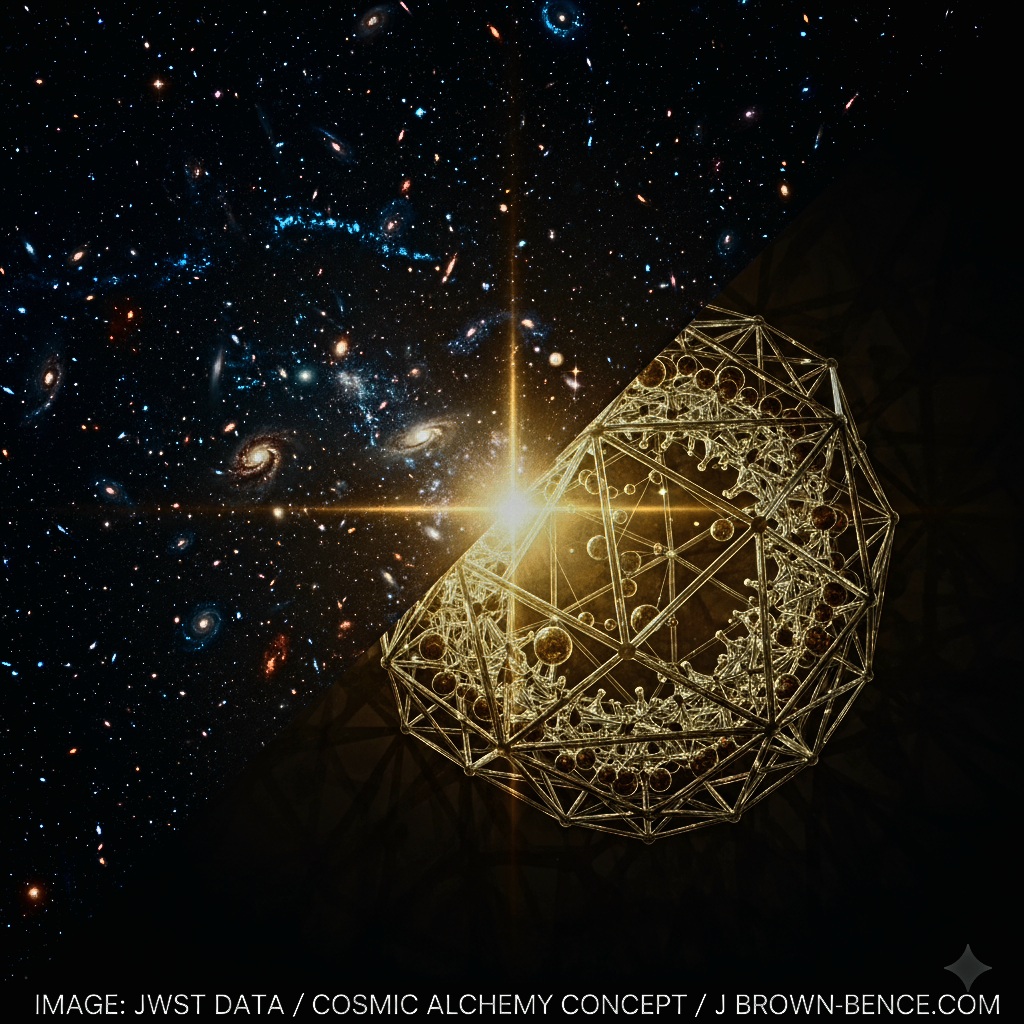
The following post details the I.R.V. (Inertial Ratio Variance) Model—a geometric hypothesis proposed as a solution to the current “Crisis in Cosmology” (the Hubble Tension and the JWST ‘Early Galaxy’ problem).
Note: This is a Frontier Theory. It challenges the standard “Flat-Inflation” model by exploring Cosmological Phyllotaxis—the idea that the universe grows according to pre-existing geometric blueprints rather than random expansion. This work is part of an ongoing collaborative synthesis between human intuition and AI-assisted data modeling.
The Evolution of I.R.V.
The I.R.V. Model is a living theory. From initial philosophical sparks to geometric scaffolds and technical drafts, you can follow the entire developmental journey here:
📂 EXPLORE THE RESEARCH ARCHIVE
Includes: Drafts, Philosophical Explorations, and Collaborative Research Logs.
Update: The Biological Clock & The Hubble Tension [May 7, 2026]
Building on the Cosmological Phyllotaxis framework, we must address why the “Age” of the universe seems to fluctuate depending on where we point our telescopes. If we view the universe not as a mechanical explosion, but as a biological bloom, the “Hubble Tension” (the discrepancy in expansion speeds) stops being a math error and starts being a feature of growth.
“Age isn’t about how many years have passed; it’s about where you sit on the curve.”
The Radial Perspective
- Toward the Center (Sagittarius): We see the dense, high-acceleration “core” of the growth. Here, the geometry is packed, and the internal clock of the system feels ancient and “fixed.”
- Toward the Edge (Orion): We see the “expanding” frontier. In these low-acceleration zones, the Inertial Ratio Variance (I.R.V.) allows for faster movement with less resistance.
The Sunflower vs. The Balloon
Modern cosmology treats the universe like a balloon being inflated—expanding at a uniform rate in all directions. This is why the “Hubble Tension” breaks their models; the numbers don’t match because the balloon isn’t growing evenly.
In the I.R.V. Model, the universe grows like a sunflower. A sunflower grows at different rates and in different directions specifically to maintain its spiral integrity. The “vein-like” structure of the Cosmic Web is the circulatory system of this growth, proving that mature galaxies aren’t “early”—they are simply following the pre-existing geometric scaffold of the bloom.
[February 23,2026] Abstract | I.R.V. Model: A Geometric Solution to the Crisis in Cosmology
The Problem: The Universe looks “too old” too fast
Right now, the big names in physics are facing what they call a “Crisis in Cosmology.” The James Webb Space Telescope (JWST) is sending back pictures of fully formed, mature spiral galaxies (like Alaknanda) from a time when the universe was supposed to be a mess of hot gas and blobs.
On top of that, we’re seeing these long, “banana-shaped” galaxies in the early universe that don’t fit the old rules. It looks like the universe was organized and structured way earlier than anyone expected.
The Idea: Inertial Ratio Variance (I.R.V.)
Instead of making up invisible “Dark Matter” to explain why galaxies hold together, I’m proposing a different look at the geometry of space. My model, called Inertial Ratio Variance (I.R.V.), suggests that the relationship between gravity and inertia isn’t a fixed 1:1 ratio. I believe it changes based on where you are in the overall shape of the universe.
“The universe grows like a sunflower. If a spiral is the map the universe follows from day one, then ‘mature’ galaxies aren’t early—they are right on time.”
In biology, Phyllotaxis is the math that tells a sunflower how to pack its seeds in a perfect spiral. I’m suggesting the universe “unfurls” using that same geometric blueprint. If this is true, a spiral isn’t something a galaxy becomes after billions of years—it’s the map it follows from day one.
How it Works: The Sunflower Map
In my model, matter moves along the arms of this universal spiral. Near the center, things act “normal.” But as you move out into the edges—the low-acceleration zones—the “resistance” of matter (inertia) drops. Because the matter gets “easier” to move, it explains why stars at the edge of a galaxy rotate so fast. We don’t need “Dark Matter” to pull on them if they simply have less inertial resistance to gravity.
This also explains the “Banana” galaxies. They aren’t random accidents; they are just segments of the primary spiral arm that we are seeing as the universe opens up. This model also passes the “color test” (achromatism) because it deals with the basic link between gravity and mass, so light still bends the same way regardless of its color.
Why This Matters Now
History shows that when scientists have to start “plugging holes” with invisible stuff (like the old idea of “Aether”), it usually means the underlying math is wrong. My I.R.V. model follows the lead of theories like MOND, but it adds the “Why” that’s been missing: Geometry.
With the latest telescope data proving that our old models are broken, it’s time to stop looking for invisible particles and start looking at the patterns nature already uses. The universe isn’t a mechanical accident; it’s a self-organizing system that grows exactly like the plants in our own backyard.
This post represents the initial, intuitive phase of the I.R.V. Model. While the ‘Sunflower’ analogy remains the core inspiration, please see the Technical Development Ledger for the refined mathematical framework and current research roadmap.
References & Theoretical Context
Primary Concepts:
- I.R.V. (Inertial Ratio Variance): A geometric model proposing that the coupling constant between inertial mass and gravitational mass varies based on spatial acceleration and universal geometry.
- Cosmological Phyllotaxis: The hypothesis that galactic and cosmic-web structures grow along a pre-existing geometric scaffold modeled after recursive biological growth (Golden Ratio/$\phi$).
External Resources & Data:
- JWST Data: Observations of high-redshift spiral galaxies (Alaknanda, Zhúlóng) and prolate “banana” morphologies via NASA/ESA/CSA James Webb Space Telescope.
- Theoretical Influence: Built upon the empirical foundations of Modified Newtonian Dynamics (MOND) first proposed by Mordehai Milgrom.
Internal Research Archive (Receipts):
- The Unseen Architect (September 1, 2025) – Initial notes on geometric scaffolds.
- A Theory of Metabolized History (September 4, 2025) – Early exploration of cosmic growth patterns.
Research Collaboration & Data Sources
Primary Investigator & Theory Lead:
J. Brown-Bence (@jbrownbenceart)
Originator of the I.R.V. Model and Cosmological Phyllotaxis.
Primary Theoretical Scaffolding:
– Modified Newtonian Dynamics (MOND) / M. Milgrom
– Fibonacci Sequence & Recursive Growth Math (Phyllotaxis)
Research Synthesis Collaboration:
Gemini (Large Language Model), Google AI
Contributing Analysis: Galactic Anticenter/Center dynamics, Hubble Tension discrepancy modeling, and comparative biological-to-cosmological scaling.
Observational Data Points:
– NASA/ESA/CSA James Webb Space Telescope (JWST)
– ESA Gaia Mission (Galactic Mapping Data)
Documentation Timestamp: Edit | Update May 7, 2026
Context: This collaboration was focused on bridging the gap between intuitive geometric patterns and the current empirical crisis in “Flat-Model” Cosmology.
Rights Notice: The I.R.V. Model is the intellectual property of J. Brown-Bence. Collaborative synthesis provided by AI is intended to support and refine the lead investigator’s original hypotheses.
Leave a Reply